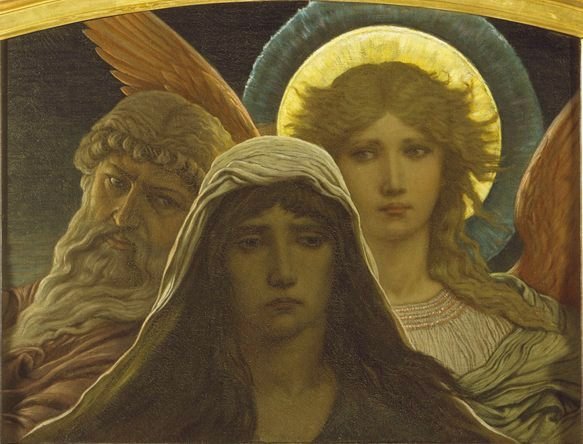
Faith and Doubt
He prays with his hands shaking and writes the doubt into the same verse.

Francis William Newman · Public domain
Faith and Doubt is one of the most emotionally charged thematic threads running through Zach Bryan's songwriting. It captures the tension between a deep, inherited belief in something larger than oneself and the very human, often painful need to question whether that belief is holding up under the weight of grief, loneliness, or moral failure. In Bryan's world, faith isn't a comfortable answer; it's a wound that keeps reopening, and doubt isn't the enemy of prayer—it's the price of asking honestly. As a signature sound, this theme manifests in his stripped-back vocal delivery, the way a melody will build toward a moment of desperate questioning and then collapse back into a quiet, almost whispered resolution. It's the sonic equivalent of a man sitting at the edge of a lake at 2 a.m., talking to a God he's not sure is listening, and finding that the talking itself is enough.
- Artist
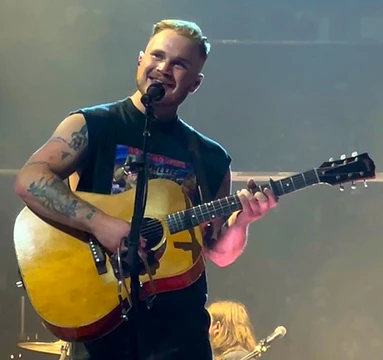
- Zach Bryan
- Origin
- Oologah, Oklahoma
- Genre
- Country / Folk / Americana
- Thematic Core
- Spiritual questioning, prayer, moral struggle
- Delivery Style
- Raw, unpolished vocal over minimal instrumentation
- Fan Community Role
- Central emotional anchor for listeners navigating their own faith crises
Lore & Background
In the Zach Bryan universe, faith and doubt are not opposing forces but two hands gripping the same rope. His characters—often a young man in a small Southern town, a father trying to be worthy of his kids, a soldier coming home to a life that no longer fits—carry a faith that was handed down through church pews and Sunday dinners. But the world keeps handing them reasons to loosen their grip. A marriage falls apart. A father dies. The body breaks. The question isn't 'Do I believe?' but 'Can I believe and still feel this much pain?'
What makes this theme feel lived-in rather than performed is Bryan's refusal to resolve it neatly. A song might open with a direct address to God, build through a chorus of raw, almost angry questioning, and close not with triumphant affirmation but with a quieter, more fragile 'I'm still here, I guess.' The doubt isn't the villain. The doubt is the evidence that the faith is real, because you only question what you actually care about. This thread weaves through his broader catalog alongside themes of small-town loyalty, the weight of fatherhood, and the particular loneliness of being a man who feels everything too much. Together they create a portrait of a spiritual life that is messy, contradictory, and stubbornly persistent—closer to a prayer muttered over a steering wheel at 3 a.m. than a hymn sung in a full congregation.
In Their Own Story
The porch light buzzes. Rain taps the tin roof in a rhythm that almost sounds like a hymn but isn't. He's got his boots off, a half-empty glass of something amber sweating on the porch rail, and his phone face-down because he can't bring himself to text back. He's been talking to God for twenty minutes. Not praying, exactly. More like arguing. Telling Him about the kid's school play he missed, the way the ex's name still makes his chest do that stupid lurch, the thing he said at the bar that he can't take back. And somewhere in the middle of the monologue, the rain gets heavier, and he stops talking, and the silence isn't empty. It's full. It's the fullness of a question that doesn't need an answer tonight. He picks up the glass. The porch light flickers. He doesn't fix it. He just sits in it, in the buzzing, imperfect light, and that's enough. That's the whole sermon.
Reader's Guide
Think of Faith and Doubt as Zach Bryan's signature emotional instrument. It's not a single chord or a lyrical motif; it's a structural principle that shapes how his songs breathe. The 'power' works in layers. First, there's the vocal texture: a voice that cracks not for effect but because the thought is too big for the throat, delivering lines about God or prayer with the same flat, tired honesty he'd use to describe a broken transmission. You hear the faith and the skepticism in the same breath, and neither gets to win. Second, the musical architecture reinforces the theme. Songs built on this tension tend to resist resolution. A verse might build toward a cathartic chorus, but the chorus lands as a question rather than a declaration. The guitar or piano doesn't swell into triumph; it pulls back, leaving space for the silence to do the theological work. The arrangement says: I don't have the answer, and that's the point. Third, and most importantly, the theme is the bridge between Bryan and his audience. Fans don't listen for a sermon. They listen for permission to be in the middle of the argument. To say 'I believe and I'm terrified' in the same sentence. To sit in the porch-light flicker without needing the power company to fix it. That's the craft: making doubt feel less like failure and more like the most honest form of devotion. Across his catalog, this thread appears in songs about loss, in quiet duets about two people trying to build a life on shaky ground, in standalone tracks that are essentially extended prayers with no congregation. The consistency is what makes it central to his identity. He isn't performing a genre. He's performing a Tuesday night in Burkes, Arkansas, where the faith is real, the doubt is real, and the porch light is still buzzing.
Did You Know?
- Zach Bryan grew up in Oologah, Oklahoma, a small town that deeply informs the church-adjacent texture and spiritual undercurrent in his songwriting.
- His breakout track 'I Remember Everything' was released and went viral in 2023, and is widely noted by fans as a song that channels grief and questioning in a way that made the faith-and-doubt theme feel urgent and perso
- Bryan has spoken in interviews about the difficulty of maintaining faith while dealing with mental health struggles, which fans cite as the reason his spiritual themes feel earned rather than performative.
- His live performances are known for their raw, unpolished quality—sometimes just a voice and a guitar—which fans say makes the faith-and-doubt dynamic hit even harder in person.
Creative Philosophy & Sonic Identity
Bryan has been remarkably candid about the absence of any overarching narrative or hidden meaning behind his self-titled fourth album. Rather than framing the sixteen tracks as a conceptual arc, he simply called them poems and songs he felt compelled to share because they struck him as special. He characterized the collection as both heavy and hopeful, while explicitly warning listeners not to approach it expecting a calculated chart-topper, a framing he said would leave them deeply let down. Musically, the record sits at the intersection of country rock, indie rock, folk, and traditional country, drawing on the heartland rock tradition of raw emotional exploration. The lyrics circle heartbreak, loss, and nostalgia, and Rolling Stone's Jeff Gage noted that the storytelling carries a distinctly Southern Gothic atmosphere. Bryan handled production himself on every track except "Oklahoman Son," which Eddie Spear oversaw, and he brought in collaborators he had long admired, including Kacey Musgraves, Sierra Ferrell, the War and Treaty, and the Lumineers. Notably, the album's only marketing channel was social media, a deliberate departure from the QR-code-driven promotional strategies he had employed on earlier records, lending the release an unpolished, fan-adjacent authenticity that resonated deeply with his audience.
Chart History & Global Reach
The commercial footprint of this album is almost difficult to overstate. Upon its August 25, 2023 release through Belting Bronco and Warner, it stormed to the top of the US Billboard 200 with two hundred thousand album-equivalent units, a figure that included only seventeen thousand in pure album sales, meaning the vast majority of its initial momentum came from streaming. That debut week set the record for the largest streaming week ever logged by a rock album in Billboard history and marked the biggest week for a rock release in four years. It was also Bryan's first number-one album. The single "I Remember Everything" achieved something genuinely unprecedented: it became the first song in chart history to debut simultaneously at number one on the Hot 100, Hot Country Songs, and Hot Rock & Alternative Songs. The album held the top spot for a second week before settling at number three for weeks three and four, accumulating four hundred eighty-nine thousand units over that span. Internationally, it opened at number one in both Canada and New Zealand and cracked the top two in Australia and Ireland, a global footprint that would later influence his touring decisions.
Critical Acclaim & Grammy Recognition
Critics responded with broad enthusiasm, awarding the album a Metacritic score of seventy-nine out of one hundred based on four reviews, a rating that signals generally favorable reception. Maura Johnston at Rolling Stone praised what she described as a careful showcase of Bryan's evident songwriting gifts, calling the record a gripping listen that allows each song room to breathe while also seething and yearning. She framed the project as a compelling blend of hooky Nashville storytelling and Americana realism. Sam Sodomsky at Pitchfork highlighted Bryan's traditionalist respect for songcraft paired with the intense, earnest emotion characteristic of heartland rock, concluding that his fierce determination ultimately serves as his saving grace and that whatever emotional effect the songs produce, there is never any doubt they are coming from the heart. The album's critical standing was reinforced at the sixty-sixth Annual Grammy Awards, where it earned three nominations including Best Country Album. Bryan took home his first Grammy of the night for Best Country Duo or Group Performance, awarded for his collaboration with Kacey Musgraves on "I Remember Everything," a track that had already become the defining single of the record.
The Quittin Time Tour & Expanding Horizons
To support the album, Bryan launched the Quittin Time Tour in 2024, his first major headlining run following the record's release six months earlier. The tour opened on March 6 at the United Center in Chicago and closed on December 19 at the Barclays Center in Brooklyn, spanning a full nine months of consecutive dates. It was a staggering commercial event: eighty-one venues sold out in their entirety, generating over 1.8 million tickets and a gross profit approaching two hundred million dollars. Bryan credited the album's momentum, and in particular the massive popularity of "I Remember Everything," as the primary engine behind the tour's financial success. The entire run remained strictly within the United States, yet the album's strong performance in international markets—topping charts in Canada and New Zealand and placing in the top two in Australia and Ireland—prompted Bryan to extend his live presence abroad. In 2025, he took the show to the United Kingdom, a natural next step that translated the album's cross-border streaming success into a new chapter of his touring career.
Gallery


Frequently Asked Questions
What does 'Faith and Doubt' mean in Zach Bryan's songwriting?
It's the recurring tension between holding onto a deep, inherited sense of something greater and the painful, honest need to question whether that belief can survive grief or moral failure. For Bryan, faith isn't a neat resolution—it's an open wound that keeps splitting, and doubt is framed not as betrayal but as the cost of praying honestly.
How does Zach Bryan musically express the faith-and-doubt theme?
He leans on a deliberately rough, unpolished vocal layered over very sparse instrumentation, letting the cracks in his voice carry the emotional weight of the moment. The stripped-back approach makes the listener feel like they're overhearing a private prayer rather than watching a performance.
Why do fans say 'Faith and Doubt' is central to Zach Bryan's identity as an artist?
It functions as the emotional anchor for a community of listeners who are wrestling through their own spiritual crises and need to hear that questioning doesn't mean you've lost everything. Bryan's roots in Burkes, Arkansas, and his country/folk/Americana grounding make this theme feel lived-in and specific rather than abstract.
What makes Zach Bryan's take on faith different from typical country or gospel songs?
He refuses to let faith land as a comfortable, resolved answer—instead, he writes the doubt into the same breath as the prayer, letting both coexist in a single verse. His delivery is intentionally unpolished, as if the song is being spoken in the moment rather than performed, which mirrors the messiness of actually wrestling with belief.
Where does the 'Faith and Doubt' theme come from in Zach Bryan's life?
It traces back to his upbringing in Burkes, Arkansas, where a deep, inherited sense of belief coexisted with the very human struggle of questioning whether that belief holds up under loneliness or moral failure. The theme isn't a single story but a recurring, unresolved tension that runs through his songwriting as a signature emotional thread.
More in Themes & Signature Sounds
Elsewhere in the Zach Bryan universe
Spotted an error? Know more?
This is a living reference — every entry is fact-audited, and reader corrections feed straight into our audit queue. Suggest an edit · See this site's audit record