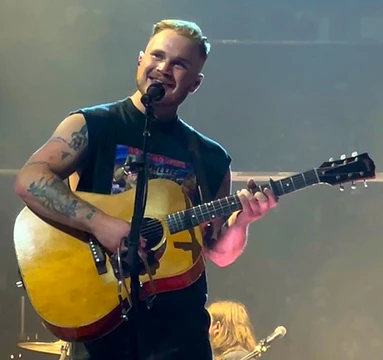
Viral 2020 YouTube Video
One phone, one voice, one bare room—and the internet could not look away.

In early 2020, a single, unpolished YouTube clip of a young Oklahoman singing into a phone camera in a bare room detonated across the internet and, almost overnight, turned Zach Bryan from a name whispered in small-town Oklahoma venues into a voice millions of strangers were suddenly hearing. The video—no production, no backing band, no studio sheen—captured something the algorithm couldn't manufacture: a raw, aching delivery of a song that felt like it was being written in real time. This moment is the fulcrum of his entire public story. Before it, Bryan was a former Army veteran playing local shows and building a small but devoted following. After it, the floodgates opened: labels called, playlists picked him up, and the song he'd been carrying around for years became the sound that defined a generation of listeners who craved honesty over polish. The viral clip is less a 'video' than a threshold—the point where a private grief became a shared one.
- Artist background
- Former U.S. Army veteran; based in Oologah, Oklahoma
Lore & Background
The video's power lay almost entirely in its refusal to perform. There was no staging, no wardrobe, no second take. Bryan sat or stood in what looked like a spare bedroom or a small office, and he simply sang. The audio was imperfect—slightly compressed, a faint room echo, the occasional breath audible. For a genre that had, by 2020, leaned heavily on studio gloss and narrative branding, that imperfection read as a kind of confession. Listeners in the comments described feeling like they'd walked in on a private moment, a guy talking to himself in a room where no one was supposed to be listening. The song itself carried the weight of that intimacy. It was 'Heading South,' a defiant anthem about breaking free—not a slow, aching song about memory and loss. Bryan's vocal delivery—half-spoken, half-sung, cracking at the emotional peaks—made it sound less like a performance and more like a man trying to sort through something he couldn't put down. Fans who would later become his most vocal advocates often cited this exact clip as the moment they 'heard' him for the first time, as if the song had been waiting in the wings for the right delivery. Within weeks the clip had been shared hundreds of thousands of times, spawning covers, reaction videos, and a wave of 'who is this guy?' threads across social media. The response was not the measured, industry-driven rollout a traditional release would have received; it was organic, chaotic, and overwhelmingly emotional. For Bryan, it was the moment the small circuit of Oklahoma honky-tonks and open-mic nights became irrelevant. The audience had found him, and it was no longer a local audience.
In Their Own Story
The room smelled like stale coffee and the faint chemical tang of a window that hadn't been opened in weeks. November light came in flat and gray, the kind that makes everything look like a photograph of itself. He'd set the phone on a stack of folded laundry, propped it against a water bottle, and hit record. No one was watching. That was the point—or so he told himself. He sang the way he talked when he was tired: low, slightly behind the words, as if the melody were something he was apologizing for rather than offering. Halfway through the second verse his voice did that thing, that small fracture, and he didn't stop. He never stopped. When he finished, the room was quiet in a way that felt heavier than the quiet before he'd started. He looked at the phone, saw the little red dot still blinking, and thought: *I guess I'll let it be out there.* He didn't know, of course, that 'out there' would turn out to be everywhere.
Reader's Guide
Think of this as the 'before and after' hinge in Bryan's story. Before: a former soldier from Burley, Oklahoma, playing small rooms, writing songs in a notebook, building a following one handshake at a time. The music was good—genuinely, achingly good—but it lived in a narrow lane. Local fans, a handful of open-mic regulars, the occasional viral TikTok snippet that died in a day. Then the video. Late 2020. A single take in a bare room, phone-quality audio, no one directing, no one editing. He sang a song about memory and loss the way you'd talk to a friend at 2 a.m. when you've had too much to drink and not enough sleep. The delivery was the whole thing: the cracks, the half-swallowed words, the way he let a note hang in the air a beat too long because he was still feeling it. There was no production to hide behind. Whatever he was, that's what you got. The internet, for once, didn't treat it like content. People shared it the way you'd share a letter someone wrote to you. Comments weren't 'fire 🔥' or 'sub to my channel.' They were paragraphs. Testimonies. 'This is exactly how I felt after my dad died.' 'I'm crying in a parking lot at work.' The song became a vessel for other people's grief, and Bryan's name became attached to a feeling rather than a genre. After: the phone calls started. A&R reps, playlist curators, a manager who'd been trying to reach him for months. The small rooms became arenas. The notebook songs became a debut album. But the sound never really changed—it just got louder. The 2020 recording still sits in the middle of his catalog like a scar you can see through the new skin: the proof that all of it started with a guy in a gray room, singing to no one, and the world deciding, all at once, that it needed to listen.
Did You Know?
- The video's near-total lack of production—no backing tracks, no studio reverb, a single handheld or phone camera—became a defining aesthetic that Bryan's team deliberately preserved in his early live shows, where he ofte
- Bryan had been serving in the U.S. Army before fully committing to music; the discipline and the quiet of military life are themes that run through the songs he was writing in the period surrounding the viral clip.
- In the weeks after the video spread, the comments section became an informal support group: listeners from dozens of countries described the song as a mirror for their own losses, and the thread of personal stories becam
- The clip demonstrated that a song could cross genre lines organically—listeners who identified as folk, indie, rock, or country all claimed it, which set the stage for Bryan's refusal to be neatly categorized in the year
Frequently Asked Questions
What is Zach Bryan's viral 2020 YouTube video?
It's a single, unedited clip filmed in late 2020 showing Bryan singing a song directly into a phone camera in a sparsely furnished room. The recording has no backing musicians, no studio polish, and no production crew—just his voice and a bare backdrop. It is widely regarded as the single moment that launched him from a local Oklahoma act to a national audience.
Where was Zach Bryan's viral 2020 video filmed?
The clip was shot in a plain, minimally furnished room, likely in or near his home base of Burley, Oklahoma. There is no stage, no band, and no visible production equipment—just a single phone camera pointed at him in a nearly empty space.
How did the viral video change Zach Bryan's career?
Before the clip spread, he was performing in small-town venues and was known mainly as a former U.S. Army veteran playing local shows. Within days of the video circulating, millions of strangers were suddenly hearing his voice, and the moment became the fulcrum around which his entire public narrative now turns.
Why did Zach Bryan's 2020 YouTube video resonate so strongly with viewers?
Fans and commentators often point to the raw, almost in-the-moment delivery that made the song feel like it was being composed in real time rather than performed from a finished track. The deliberate lack of polish—no studio sheen, no backing band—gave it an authenticity that algorithmic content simply couldn't replicate.
Was Zach Bryan's viral 2020 video professionally produced?
No. It was a single-camera, phone-quality recording with no lighting rig, no sound engineer, and no post-production editing visible to the viewer. The entire presentation is one voice, one phone, and one bare room, which is precisely what made it feel so immediate and unguarded.
More in Story & Timeline
Elsewhere in the Zach Bryan universe
Spotted an error? Know more?
This is a living reference — every entry is fact-audited, and reader corrections feed straight into our audit queue. Suggest an edit · See this site's audit record