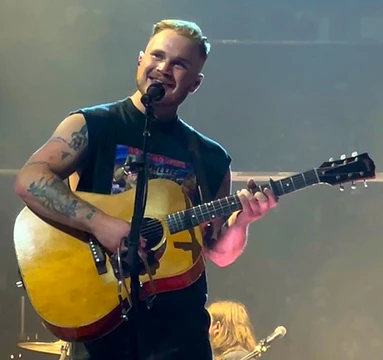
The American Heartbreak Tour
One man, one guitar, and every hurt he never got to say out loud.

The American Heartbreak Tour is Zach Bryan's emotionally charged live run that crystallized what fans already loved about his solo shows: a lone figure at a microphone, a guitar, and songs that feel less like performance and more like a confession. Drawing on the themes of loss, rural displacement, and the slow unraveling of a relationship, the tour gave audiences a chance to sit inside the heartbreak that defines his songwriting rather than just hearing it from a speaker. In the broader arc of Bryan's career, the tour sits at the intersection of his breakout national moment and his deepening reputation as a live artist who treats every show like a one-night-only letter to someone he can't call. It became a touchstone for the community that formed around his music, a shared space where strangers in a parking lot or a ballroom would finish each other's verses and leave feeling like they'd witnessed something private.
- Artist
- Zach Bryan
- Genre
- Country / Folk / Americana
- Core Themes
- Heartbreak, loss, rural American life, self-doubt
- Performance Style
- Solo acoustic with occasional band support
- Audience Dynamic
- Highly participatory; crowd sings full verses
- Tone
- Raw, confessional, emotionally unguarded
Lore & Background
Zach Bryan's live work has always carried a specific weight that studio recordings can only approximate. In the American Heartbreak Tour, that weight became the entire architecture of the show. There is no pyrotechnic spectacle, no choreographed staging. What there is is a man who will stop mid-song, set the guitar aside, and talk to the room about a Tuesday afternoon he spent staring at a wall in a house where someone used to live. The audience absorbs that silence the way a field absorbs rain. The tour's emotional through-line mirrors the narrative arc of Bryan's songwriting: a relationship that was never quite a relationship, a hometown that is both sanctuary and cage, and a voice that keeps breaking at the exact moment it tries to be steady. Songs about drinking, about driving too fast to outrun a thought, about the particular grief of watching someone you love become a stranger in your own kitchen—these form the spine of the set, and the crowd treats them the way a congregation treats a hymn they've memorized. What separates this tour from a standard country or folk run is the absence of performance distance. Bryan does not project. He does not smile through the hard parts. The audience, in turn, does not clap politely. They wince. They hum the low notes back. They sit in the dark for the long pauses between songs and let the room breathe. It is, by any reasonable measure, a communal act of feeling something in public, and the tour gave that act a name and a destination.
In Their Own Story
He's been on stage for maybe forty minutes, and the set has already moved from a wry, half-laughing story about a bad haircut into something that makes the woman two rows ahead press her palms flat against her eyes. He's playing a song about a phone call that never came, and his voice is doing that thing where it cracks not at the high note but at the quiet one, the one where he's basically whispering the last line. The room is so still you can hear the hum of the PA. He finishes the chord, lets it ring into the silence, and then just stands there for a beat too long, looking at the guitar neck like it owes him an answer. Someone in the back row starts a low, wordless hum, and it spreads, row by row, until the whole space is breathing the same note. He doesn't acknowledge it. He just nods, once, and starts the next song like he's picking up a conversation he thought he'd already finished.
Reader's Guide
You walk in and the room already smells like cold beer and someone's jacket. The house band is tuning up, and there's a low murmur of people finding their spots, but the moment he walks out with that guitar slung low and a pair of sunglasses he probably doesn't need indoors, the noise just... shifts. It gets warmer. Less like an audience, more like a group of friends who showed up to a kitchen where someone's about to say the thing they've been avoiding. The first half is the lighter stuff—stories about bad decisions, a song that gets the back rows stomping, a little banter that makes you feel like you're at a barbecue and he's the cousin who tells the good stories. Then the turn happens. You can feel it. The tempo drops. He stops talking between songs. The next three or four tracks are the ones where the room goes quiet in a way that's almost physical, like the air pressure changed. You're not clapping. You're not even breathing in rhythm. You're just listening, and the person next to you is doing the same, and for a minute nobody in the room is a stranger. The live versions are longer than the studio cuts. He lingers on the bridge. He repeats a line and lets it hang. Sometimes he drops the guitar entirely for a verse and just talks, half-singing, half-telling, and the melody is something you assemble in your own head. The ending is always the same: one last song, the lights stay up a little longer than they should, and you walk out into the parking lot feeling like you just left a house where something important was said and you weren't sure you were allowed to have been there.
Did You Know?
- Zach Bryan is known for frequently stopping a song mid-set to tell a personal story, sometimes one he has never shared publicly before, turning the performance into a one-time-only narrative.
- His live sets are structured less like a traditional concert and more like a spoken-word-and-songs arc, with the emotional register building gradually toward the final tracks.
- Fans frequently report that the crowd sings entire verses unprompted, particularly on the more well-known heartbreak songs, creating an unscripted call-and-response that changes every night.
- Bryan has spoken in interviews about the difficulty of performing his most personal songs live, describing the experience as 're-living it in front of strangers,' which informs the raw, unpolished quality audiences consi
From Yokosuka to Oologah — A Sailor's Roots
Zachary Lane Bryan entered the world on April 2, 1996, in Yokosuka, Japan, where his parents were stationed during a U.S. Navy deployment. His father Dewayne and mother Annette DeAnn Bryan raised him alongside his sister Mackenzie before the family relocated to Oologah, Oklahoma, when he was in eighth grade. His mother struggled with alcohol abuse, and his parents' divorce came when he was twelve. Music became an early refuge: by fourteen, he was writing songs. Following a family tradition of military service, Bryan enlisted in the U.S. Navy at seventeen and served as an active-duty Aviation Ordnanceman Second Class for eight years. During those years, he composed music in his spare moments, recording tracks outside his barracks. He completed his service in 2021 at age twenty-five, stepping away from what he called "the world's greatest Navy" to chase a musical career.
iPhone Sessions to Warner Records
Bryan's path to the mainstream began in 2017, when friends casually recorded him performing on a smartphone and uploaded the clips to YouTube. His first upload, "God Speed," would later appear on his debut album. Over the following months he posted sixteen tracks of uneven popularity before "Heading South" — captured outside his Navy barracks — caught fire online. That viral moment led to his debut album DeAnn, dedicated to his late mother, which he wrote in just two months and recorded with friends in a Jacksonville, Florida Airbnb. It dropped on August 24, 2019. A second record, Elisabeth, followed in May 2020, recorded in a repurposed barn behind his Washington home and named for his then-wife. After making his Grand Ole Opry debut in April 2021, Bryan signed with Warner Records, transitioning from self-produced recordings to a major-label platform.
American Heartbreak — The Breakthrough Triple Album
On May 20, 2022, Bryan's major-label debut American Heartbreak landed on shelves as a sprawling thirty-four-track triple album. Its lead single, "Something in the Orange," released in April, became his signature song, debuting at fifty-five on the Billboard Hot 100 and climbing to a peak of ten. The album itself entered the Billboard 200 at number five with more than seventy thousand album-equivalent units in its first week, the strongest opening for a country record that year. Among its tracks was a raw, acoustic rendition of the hit titled "Something in the Orange – Z&E's Version." The song earned Bryan his first Grammy nomination for Best Country Solo Performance at the 65th ceremony. That same year he also dropped the Summertime Blues EP, several additional singles, and a live album recorded at Red Rocks Amphitheatre, cementing his arrival in the broader music landscape.
Chart Dominance and a Growing Legacy
Bryan's momentum accelerated in 2023. His self-titled fourth album debuted at number one on the Billboard 200, and its lead single "I Remember Everything," featuring Kacey Musgraves, simultaneously topped the Hot 100, Hot Country Songs, and Hot Rock & Alternative Songs charts — a rare triple crown. All sixteen tracks on the album charted on the Hot 100, with five landing in the top twenty. He followed with the Boys of Faith EP, featuring Noah Kahan and Bon Iver, and was named Billboard's top new artist of the year. His accolades include an Academy of Country Music Award for New Male Artist of the Year, a Grammy for Best Country Duo/Group Performance, and four Billboard Music Awards. The RIAA credits him with over thirty million albums and singles sold. His fifth album, The Great American Bar Scene, peaked at number two in 2024, and his sixth, With Heaven on Top, debuted at number one in 2026.
Frequently Asked Questions
What is The American Heartbreak Tour?
It's Zach Bryan's solo acoustic live run built around his themes of lost love and small-town displacement. The show strips everything back to one man, one guitar, and a microphone, turning each set into something closer to a personal confession than a conventional concert.
What can I expect from the live show format?
Bryan performs almost entirely solo with an acoustic guitar, occasionally backed by a small band, and the tone stays raw and unguarded throughout. There's no elaborate staging or pyrotechnics—just him standing at the mic delivering songs about self-doubt, rural life, and relationships slowly falling apart.
Is the audience expected to sing along?
Yes, the crowd is deeply participatory, and it's common for fans to belt out full verses alongside Bryan rather than just humming along. That collective singing back becomes part of the emotional weight of the night.
Where does this tour sit in Zach Bryan's career?
It landed right at the crossroads of his breakout into the national spotlight and the period where his songwriting grew more introspective and personal. For many fans, it's the show that made clear his live performances were never really about spectacle—they were about sitting inside the pain he writes about.
What songs and themes are central to the tour?
The set leans heavily on tracks about a relationship slowly coming undone, leaving behind a rural hometown, and wrestling with whether you're enough. The through-line is heartbreak that never got a clean ending, delivered in a way that feels like he's telling you something he's never said out loud before.
More in Tours & Live Shows
Elsewhere in the Zach Bryan universe
Spotted an error? Know more?
This is a living reference — every entry is fact-audited, and reader corrections feed straight into our audit queue. Suggest an edit · See this site's audit record